Markets & Cycles
Market Outlook Q1 2026
21 Jan 2026

Executive Summary
The global economy enters a phase of profound upheaval in 2026. Geopolitical tensions, a more fragmented world order, and an accelerated technological revolution define the environment. Despite these uncertainties, financial markets have so far proven remarkably resilient—supported by expansive fiscal policy, loosened monetary policy, and high expectations for artificial intelligence (AI).
Central to this is the question of whether the global economy can achieve a new "escape velocity" and thus overcome traditional late-cycle dynamics. AI holds the potential to sustainably increase productivity and prolong growth. However, whether this potential is realized depends on continued funding, successful monetization, and the expansion of necessary energy and infrastructure capacities.
The growing gap between the USA and China remains a defining feature of global markets. While the USA's technological leadership supports stock markets, China's industrial policy-driven overcapacity is increasingly causing distortions—particularly in Europe. At the same time, rising sovereign debt and advancing deglobalization are exacerbating structural risks.
Against this backdrop, long-term trends are gaining importance. The five structural forces—Digitalization, Decarbonization, Debt, Demographics, and Deglobalization—are already shaping the investment environment today. We see opportunities particularly in the areas of AI and Technology, Energy and Resources, and Longevity. At the same time, broad diversification and targeted portfolio hedging remain central to countering increased political and economic risks.
Disruptive Forces in a World in Transition
The world is in a phase of profound political, economic, and technological change. Trade conflicts, geopolitical tensions, structural shifts between major economic regions, and rapid progress in artificial intelligence are challenging existing orders. What triggers uncertainty at first glance also opens up new opportunities.
In antiquity, Prometheus and Pandora already symbolized this tension: progress and knowledge on one side, risks and unintended side effects on the other. Today, too, disruptive developments are developing a momentum of their own that can hardly be controlled. Hope and risk go hand in hand—and shape the investment environment at the beginning of 2026.
Resilient Markets on Fragile Foundations
Despite numerous political and economic shocks, financial markets have so far shown remarkable resilience. However, the so-called tariff shock in spring 2025, the significant weakening of the US dollar, and the accelerated rise in the gold price revealed how fragile the foundation is.
At the same time, robust economic data, falling interest rates, and high expectations for the transformative power of artificial intelligence provided tailwinds for stock markets. US technology stocks, in particular, dominated the trend. The MSCI USA achieved a significant return in US dollars in 2025, while returns for European and Swiss investors were considerably lower due to currency effects. The increasing concentration of global stock markets on a few large US technology companies also raises questions about valuations and potential exaggerations.
USA and China: A Growing Gap
The current technological revolution is clearly led by the USA. US companies today account for a dominant share of global market capitalization, while China has fallen significantly behind in stock markets. Since the end of the COVID pandemic, a marked gap has opened between the performance of US and Chinese stock markets.
Nevertheless, China remains a central actor in the global economy. Its unprecedented rise since the opening under Deng Xiaoping and its WTO accession in 2001 permanently changed global trade structures. Today, however, China faces new challenges: a persistent real estate crisis, demographic headwinds, restricted capital market liberalization, and uncertainties regarding property security.
At the same time, Beijing has been pursuing a targeted industrial policy for several years. Massive investments in key technologies have led to significant overcapacities that are increasingly pressing on world markets. This so-called second China shock is hitting Europe in particular, for example in automotive and industrial production.
Gravity Overcome? On the Way to a New Growth Phase
In physics, a minimum speed—the so-called escape velocity—is required to overcome the gravity of a massive body. Applied to the economy, the question for 2026 is whether the combination of AI innovation, expansive fiscal policy, and loosened monetary policy is sufficient to overcome classic late-cycle dynamics and enter a new growth phase.
At the center of this debate stands artificial intelligence. Its potential to increase productivity is significant. If it is possible to sustainably monetize innovations, provide sufficient capital, and build the necessary energy and infrastructure, AI could enable a new kind of economic escape velocity.
Debt, Deglobalization, and Political Gravity
Another central factor is the development of sovereign debt. In many industrial countries, government spending has already reached a level that seems difficult to sustain in the long term—especially against the backdrop of aging populations. Without structural reforms, debt levels are likely to rise further and increasingly narrow political room for maneuver.
In parallel, deglobalization is progressing. Trade, domestic, and geopolitics are becoming increasingly intertwined. Supply chains are being reorganized, economic dependencies reconsidered, and political risks re-evaluated. These forces act like a gravity of the past, likely to further increase volatility in the markets.
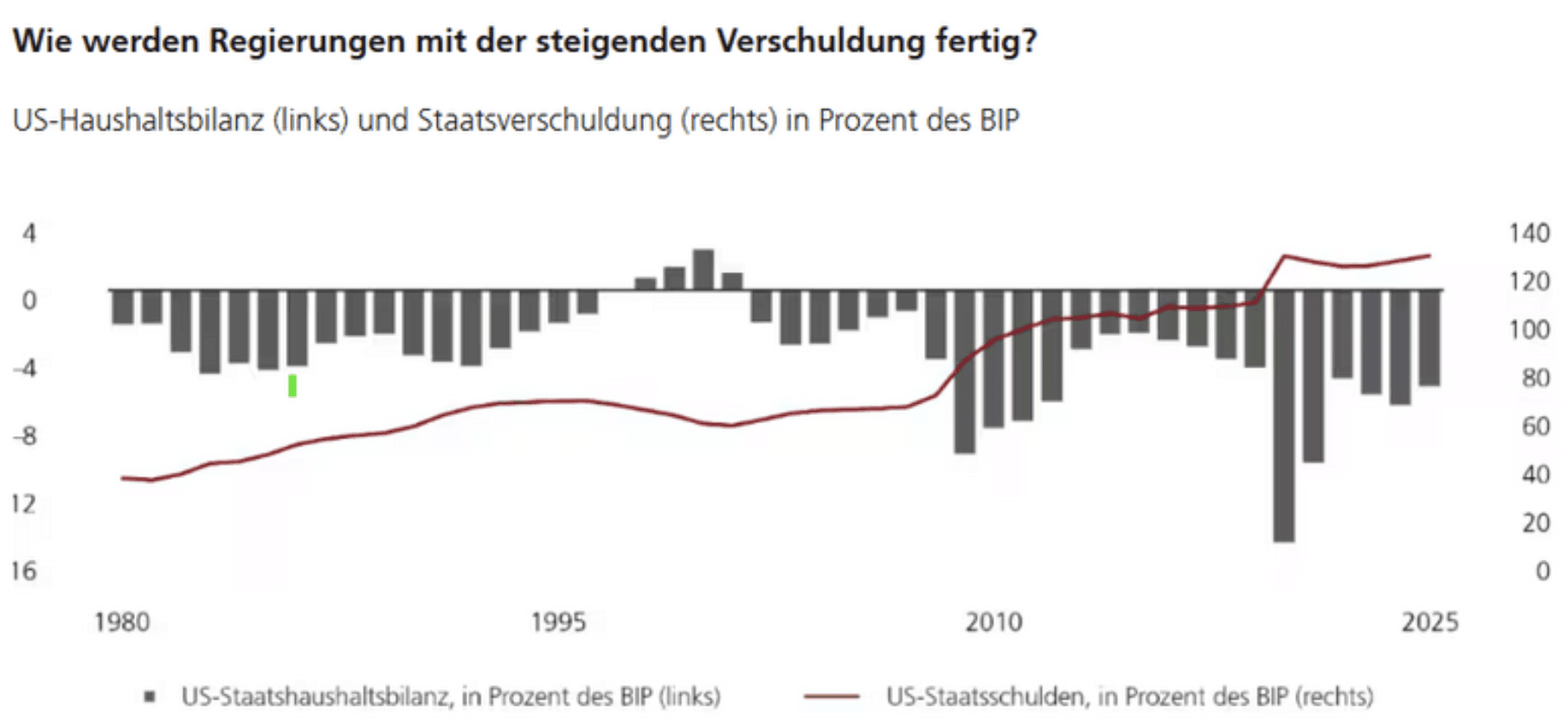
Sources: Bloomberg, UBS, as of November 12, 2025
Lasting Trends and Investment Implications
Despite all uncertainties, long-term fundamental principles are crystallizing. The five structural forces—Digitalization, Decarbonization, Debt, Demographics, and Deglobalization—are already shaping the investment environment today and will remain decisive in 2026.
Against this background, we are focusing on sectors that benefit from these forces:
Artificial Intelligence and Technology
Energy, Resources, and Raw Materials
Longevity and Demographic Change
Rising debt also points to an environment of financial repression, in which capital is increasingly directed into government bonds and yields are capped. At the same time, diversification across different asset classes and targeted portfolio hedging are gaining further importance.
Conclusion
The future remains unpredictable, but great changes always bring new opportunities. Disruptive forces harbor risks but also open paths to progress and growth. Hope and uncertainty exist side by side—just as they once did with Prometheus and Pandora.
With a disciplined analytical approach, clear principles of asset allocation, and a focus on structural trends, we are convinced that investors can successfully navigate 2026 and beyond.